
A recent debate about salaries in Aruba sparked important questions about income, affordability, and opportunity. Yet perhaps the most important question isn’t why salaries are what they are today. Perhaps it is this:
But:
What industries will create Aruba’s next generation of higher-income careers?
Tourism remains Aruba’s economic engine. Reports show its increasing % of GDP (>90% of economic activity). These figures highlight both the strength and the reality of Aruba’s economy. Tourism has created employment, investment, and prosperity for decades and will continue to play a central role in Aruba’s future.
However, they also raise an important strategic question.
If much of our economic growth is tied to a single industry, where will the next generation of high-income opportunities come from?
Historically, the path to higher earnings was relatively straightforward. Education led to a profession. Experience led to promotion. Promotion led to higher compensation.
While that path still exists, the global economy is changing.
Some of the fastest-growing industries today are built not on physical assets, but on intellectual property, digital communities, content, and attention. I am sure a few parents have now understood after hearing the thousands saying Speed, Speed, Speed in a few Caribbean islands!
Now consider sports.
For decades, sports teams were viewed primarily as entertainment businesses. Today, many investors view them as media companies.
The value of sports franchises has exploded over the last twenty years. According to Forbes, the average NFL franchise is now worth approximately US$7.1 billion, while the Dallas Cowboys alone are valued at roughly US$13 billion. These valuations are not driven solely by ticket sales. They are driven by media rights, sponsorships, content, intellectual property and global audiences.
The same transformation is occurring across gaming, media, and entertainment.
Many people still think of gaming as simply playing video games; however, investors see something very different. They see global audiences, content, sponsorship opportunities, inventory, events, communities to name a few. In a nutshell, they see business models.
The global video game industry generated approximately US$200 billion in revenue in 2024/25, making it one of the largest entertainment sectors in the world. More importantly, gaming is no longer just a product. It is an ecosystem.
A perfect example emerged just days ago when 007 First Light, the latest James Bond video game, sold more than 1.5 million copies within its first 24 hours of release, making it the fastest-selling title in developer IO Interactive’s history.
Most people see a video game but business leaders see intellectual property that has been monetized across generations.
The game is not the business.
The audience is.
Perhaps the most interesting example comes from the creator economy.
Earlier this year, YouTube creator iShowSpeed completed a highly publicized Caribbean tour and shortly afterward, he released a World Cup-themed song called “Champions,” leveraging his audience, his brand, and the momentum generated by that tour. It gained more than 40m views across platforms in less than 24hrs.
Again, the lesson is not about music.
It is about attention.
A creator can now build an audience, launch content, attract sponsors, generate advertising revenue, sell merchandise, and influence consumer behavior at a scale that was previously reserved for traditional media companies.
This is why many analysts describe the modern economy as an attention economy. Attention attracts audiences. Audiences attract advertisers, sponsors, subscribers and investors. Ultimately, attention generates revenue.
For Aruba, this presents an interesting opportunity.
In a previous analysis, I estimated that Aruba may have approximately 16,000 active gamers. While gaming is often viewed as recreation, that figure highlights something larger: digital entertainment is already a meaningful part of how younger generations spend their time, consume content, and build communities.
The opportunity is not necessarily becoming a professional gamer.
The opportunity lies in the careers being built around gaming, sports, media, and entertainment.
Professions range from Video editors Content creators to data analysts. These are increasingly global careers.
Think of it like this…
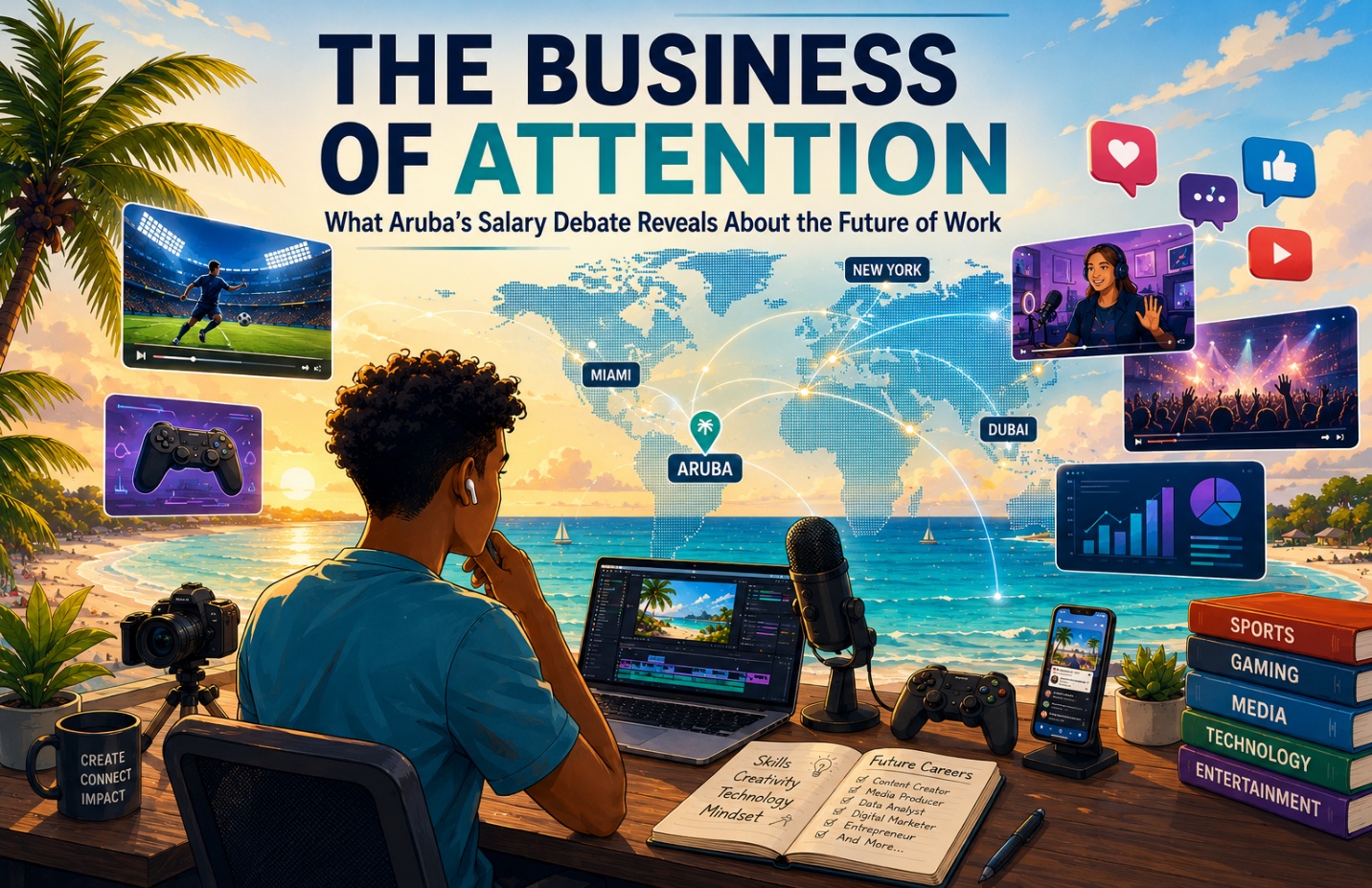
A talented video editor in Aruba can work for a creator in Miami while a graphic designer can support a sports organization in New York.
The common denominator is not gaming, sports or entertainment. The common denominator is attention and the ability to create value around it.
To conclude, tourism will remain Aruba’s economic foundation. I believe future growth and the next generation of economic opportunity may increasingly come from industries built on creativity, technology, media and intellectual property.
The objective should not be to replace tourism. Tourism will continue to be the foundation of our economy.
The opportunity is to complement it.
As Aruba continues discussing salaries and economic opportunity, perhaps the conversation should move beyond the jobs that exist today and begin considering the industries that are shaping tomorrow.
The next generation of higher-income careers may emerge not only from traditional sectors, but from the intersection of technology, sports, media, gaming, entertainment and the business of attention.
 Kwesi Charles is a corporate finance and strategy executive, writer, and entrepreneur. With over 15 years of experience spanning finance, investment management, private equity, consumer finance, and business transformation, he brings a unique perspective to the forces shaping modern business.
His writing explores where boardroom strategy meets fan culture, examining the intersection of finance, sports, gaming, media, entertainment, technology, and the economics of attention.
Continue the Conversation
Follow Kwesi Charles on LinkedIn and subscribe to Inside the Mind on Substack (kwesiinsidethemind) for more insights on business, sports, gaming, media, entertainment, technology, and the economics of attention.